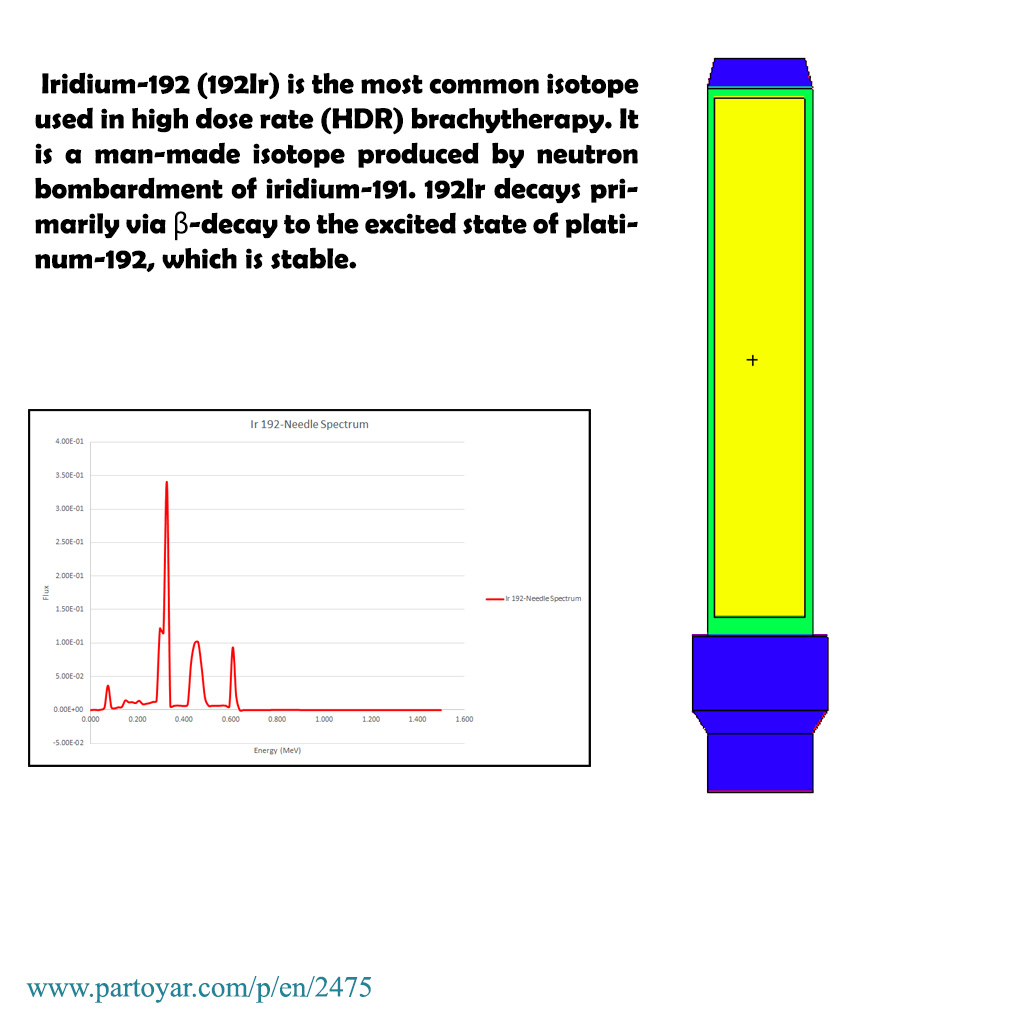
Ir192 source simulation with MCNP
Iridium-192 (symbol: 192 Ir) is a radioactive isotope of iridium.
Iridium-192 (192Ir) is the most common isotope used in high dose rate (HDR) brachytherapy. It is a man-made isotope produced by neutron bombardment of iridium-191. 192Ir decays primarily via β-decay to the excited state of platinum-192, which is stable. Approximately 5% of the decay occurs via electron capture, which produces an excited state of osmium-192, which is also stable. It is superior to cobalt-60 and caesium-137 because of its higher specific activity, which allows for smaller source sizes. One disadvantage of 192Ir is its short half-life (73.83 days), resulting in a loss of activity of approximately 1% per day. This requires the source to be changed every 3–4 months.
Table of Contents
Here are some key points about it:
-
Half-life: 73.827 days
-
Decay mode: Emits beta particles and gamma radiation
-
Uses: Commonly used in industrial radiography to detect flaws in metal components and in brachytherapy for treating certain cancers
-
Gamma radiation: Strong gamma-ray emitter with a gamma dose-constant of approximately 1.54 μSv·h⁻¹·MBq⁻¹ at 30 cm
Applications
-
Industrial Radiography: Iridium-192 is widely used in non-destructive testing to inspect metal parts and welds for internal defects. Its gamma radiation penetrates materials and helps create detailed images of the internal structure.
-
Brachytherapy: This isotope is used in internal radiotherapy for cancer treatment. Small sources of Iridium-192 are placed close to or inside the tumor, delivering a high dose of radiation to the cancerous cells while minimizing exposure to surrounding healthy tissue.
Production
-
Method: Iridium-192 is produced by neutron activation of natural iridium (Iridium-191) in a nuclear reactor. The process involves bombarding Iridium-191 with neutrons, transforming it into the radioactive Iridium-192 isotope.
Safety Precautions
-
Shielding: Due to its intense gamma radiation, Iridium-192 sources require heavy shielding, typically using lead or depleted uranium, to protect workers and the public.
-
Handling: Only trained professionals should handle Iridium-192. Proper protocols include using remote handling tools and monitoring for radiation exposure.
-
Storage: Radioactive materials must be stored in secure, shielded containers to prevent accidental exposure.
Decay and Radiation
-
Decay Products: Iridium-192 decays into platinum-192 and osmium-192 through beta and gamma emissions. It also produces several low-energy photons and beta particles.
-
Radiation Dose: The strong gamma emissions make Iridium-192 effective for imaging and treatment but also necessitate stringent safety measures to limit radiation exposure.
Simulating Iridium-192 (Ir-192) with the Monte Carlo N-Particle (MCNP) code is a common practice in medical physics, especially for brachytherapy applications. Here's a brief overview of how it's done:
Steps for Simulation with MCNP:
-
Define Geometry: Create a model of the Ir-192 source and the surrounding medium (e.g., water phantom or tissue).
-
Set Up Materials: Define the materials involved, including the Ir-192 source and the medium.
-
Specify Source: Input the characteristics of the Ir-192 source, such as its activity and geometry.
-
Run Simulation: Execute the simulation to track the transport of particles and their interactions with the materials.
-
Analyze Results: Evaluate the dose distribution, dose rate, and other relevant dosimetric parameters.
Applications:
-
Dosimetry: Determine the dose distribution around the Ir-192 source.
-
Treatment Planning: Optimize brachytherapy treatment plans by accurately simulating the dose delivered to the target and surrounding tissues
What is Brachytherapy?
Brachytherapy involves placing radioactive material inside or near a tumor. This allows for a high dose of radiation to be delivered directly to the cancer cells while minimizing exposure to surrounding healthy tissue.
Types of Brachytherapy
-
Temporary Brachytherapy: Radioactive sources are placed for a short duration and then removed. This can be done using catheters, needles, or balloons.
-
Permanent Brachytherapy: Also known as seed implantation, involves placing small radioactive seeds (about the size of a grain of rice) permanently inside or near the tumor. The seeds lose their radioactivity over time and remain in the body without causing harm.
Applications
Brachytherapy is used to treat various types of cancer, including:
-
Prostate cancer
-
Cervical cancer
-
Breast cancer
-
Lung cancer
-
Head and neck cancers
-
Eye cancer
-
Skin cancer
Procedure
-
Preparation: Patients may undergo tests like blood tests, EKGs, and scans to plan the treatment.
-
Implantation: The radioactive source is placed inside or near the tumor using needles or catheters.
-
Duration: The duration can vary from a few minutes to several days, depending on the type of brachytherapy.
-
Post-Procedure: Patients may need to stay in the hospital for a short period and follow specific care instructions.
Benefits and Risks
-
Benefits: Allows for a higher dose of radiation over a shorter period, targeting cancer cells more effectively.
-
Risks: Potential side effects depend on the treatment area and may include fatigue, pain, and temporary issues like urinary or digestive problems.